
A fresh model for public science
The Glitch'n community circuit and internship
How Glitch'n spreads: people who learn to build circuits go on to teach others.
What a pop-up looks like
One open room. Visitors drop in and go as deep as they like: listen, play with finished circuits, or build their own.
At the exit, our research team invites visitors to a short, voluntary survey.
A HOMAGO*-infused internship
Course graduates, ages 14 to 20, can join CTRL (Community Tech Research and Leadership), a paid internship running pop-ups with our teaching and research team. The three zones are their training ground: interns watch how visitors move through the room and make it better each time.
Technical skills
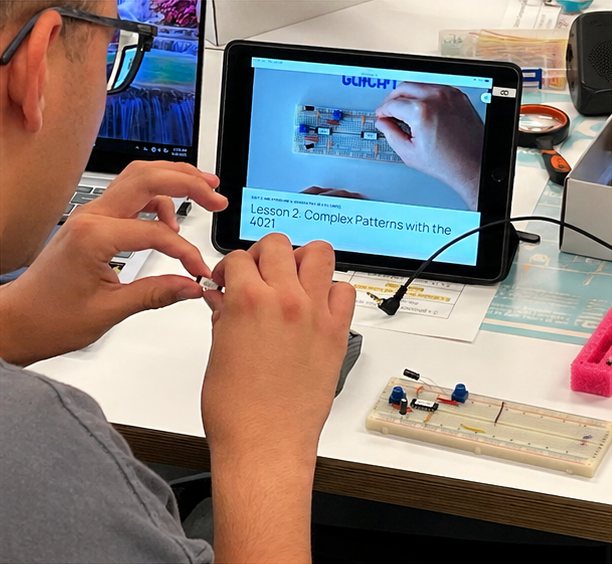
Computational thinking, circuit basics, troubleshooting electronics
Facilitation skills
Planning a pop-up, asking guiding questions, putting words to what visitors hear
Job skills
Work ethic, teamwork, problem solving
Preparation and practice
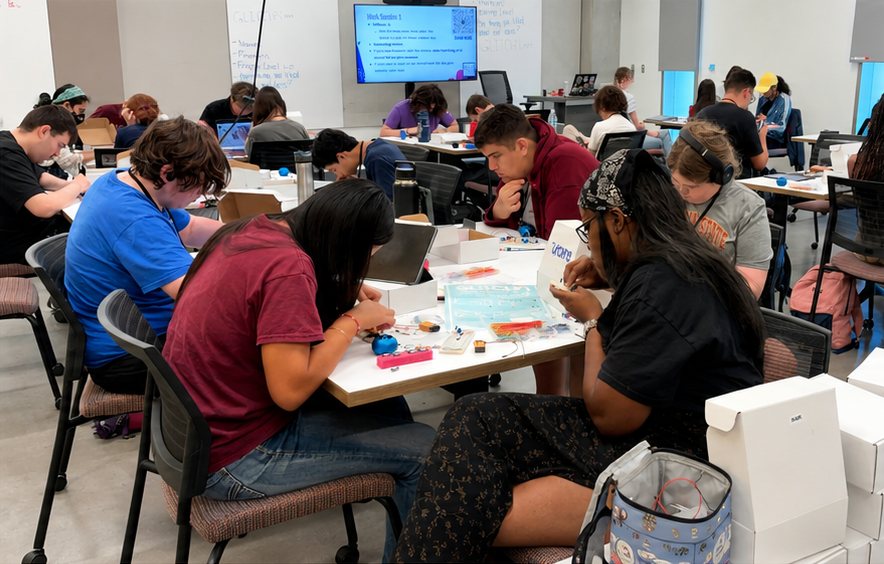
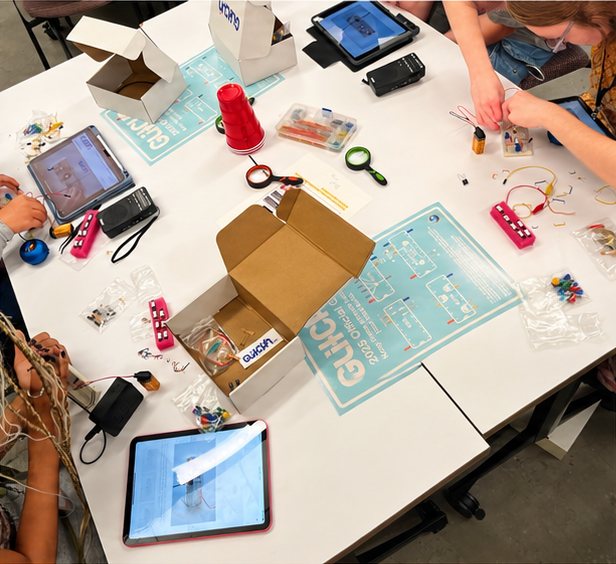
Interns set up the room themselves: signs in place, tables laid out, every circuit tested.
Before each pop-up, interns train with our team. Short questionnaires track what they are learning.
Each group seeds the next
Everyone starts as a builder. Builders who want more are paid to run pop-ups. Facilitators who keep going co-teach, then lead a course, and the people they teach start the loop again.
We start the circuit in a new place with a few teachers from the ASU Glitch'n Studio. Over time, local graduates take over the teaching.
Why a beginner can teach
Everyone learns a few baseline designs by heart. Inventing means changing one, and that often breaks the circuit. A facilitator doesn't need to know why. They steer it back to a baseline that works.
You don't have to know everything. You have to know the baselines.
Why it works
Ideas from the learning sciences, museums and electronic music.
- 90%of course participants said their interest in a technical career grew
- 30 / 58course participants applied to be paid facilitators
- 93%of pop-up visitors felt more confident with circuits
2025 end-of-course survey (58 participants; Pivovarova et al., 2026) and pop-up exit survey (96 visitors, ages 6 to 91).
References
- Akinbadewa, B., Reutlinger, C., Vasquez, A. M., & Thorn, S. (2026). From frustration to creativity: Exploring how neurodiversity-affirming learning contexts transform uncertainty into strengths. Proceedings of the International Conference of the Learning Sciences (ICLS 2026), 177–186. ISLS.
- Barron, B., Martin, C. K., Takeuchi, L., & Fithian, R. (2009). Parents as learning partners in the development of technological fluency. International Journal of Learning and Media, 1(2), 55–77.
- CAST. (2024). Universal Design for Learning guidelines version 3.0. udlguidelines.cast.org
- Collins, N. (2020). Handmade electronic music: The art of hardware hacking (3rd ed.). Routledge.
- Diamond, J., St. John, M., Cleary, B., & Librero, D. (1987). The Exploratorium's Explainer Program: The long-term impacts on teenagers of teaching science to the public. Science Education, 71(5), 643–656.
- Duran, D. (2017). Learning-by-teaching: Evidence and implications as a pedagogical mechanism. Innovations in Education and Teaching International, 54(5), 476–484.
- Ito, M., et al. (2019). Hanging out, messing around, and geeking out: Kids living and learning with new media (10th anniversary ed.). MIT Press.
- Kapur, M. (2008). Productive failure. Cognition and Instruction, 26(3), 379–424.
- Larson, K., Ito, M., Brown, E., Hawkins, M., Pinkard, N., & Sebring, P. (2013). Safe space and shared interests: YOUmedia Chicago as a laboratory for connected learning. Digital Media and Learning Research Hub.
- Lave, J., & Wenger, E. (1991). Situated learning: Legitimate peripheral participation. Cambridge University Press.
- Menkman, R. (2011). The glitch moment(um). Institute of Network Cultures.
- Petrich, M., Wilkinson, K., & Bevan, B. (2013). It looks like fun, but are they learning? In M. Honey & D. E. Kanter (Eds.), Design, make, play: Growing the next generation of STEM innovators (pp. 50–70). Routledge.
- Pivovarova, M., Reutlinger, C., Sanchez Chavarria, K., & Thorn, S. (2026). Building confidence in STEM one chip at a time. Association for Education Finance and Policy (AEFP), Chicago.
- Roscoe, R. D., & Chi, M. T. H. (2007). Understanding tutor learning: Knowledge-building and knowledge-telling in peer tutors' explanations and questions. Review of Educational Research, 77(4), 534–574.
Where we've been
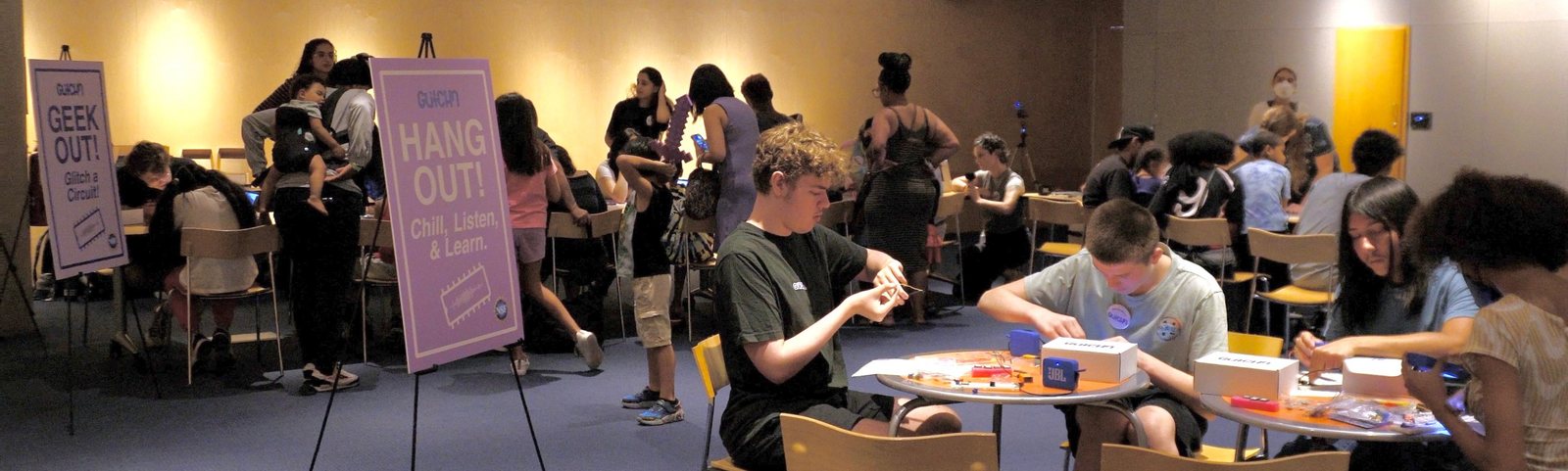
July 2025, Burton Barr Central Library in Phoenix: fourteen graduates of our first courses became paid interns and ran three pop-ups. Here is the public one.
Phoenix Conservatory of Music, July 2026
Glitch'n began with an EAGER award from the National Science Foundation's Advancing Informal STEM Learning program (Award 2432637).